Stinging insect activity in Grand Island peaks between late June and October, driven by queen establishment in wood-framed residential eaves and detached outbuildings. In established neighborhoods such as Stolley Park,…
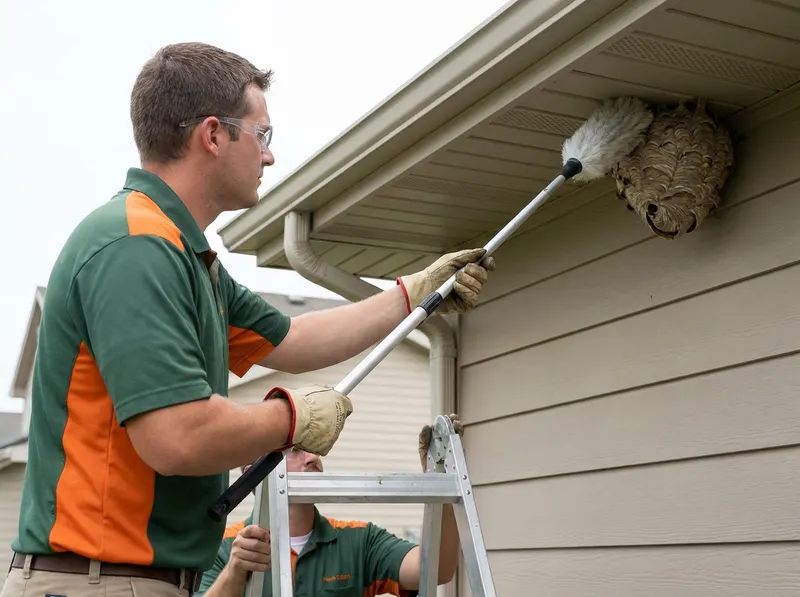
Stinging insect activity in Grand Island peaks between late June and October, driven by queen establishment in wood-framed residential eaves and detached outbuildings. In established neighborhoods such as Stolley Park, Broadwell, and Pier Park, mature shade trees and historic soffits provide sheltered harborage for aerial paper wasps and bald-faced hornets. Outlying properties near Prairie Creek and Northwest Grand Island regularly experience subterranean yellowjacket infestations in abandoned rodent burrows along property lines. Standard consumer pyrethroid sprays frequently trigger an alarm pheromone release across the colony before penetrating the brood core, causing aggressive worker counter-attacks and scattering insects deeper into structural gaps.
Professional elimination addresses the structural physics of the hive rather than basic surface spraying. When dealing with an exposed exterior paper comb beneath a deck rail or window header, technicians deploy directional aerosol freezing agents to neutralize the guard wasps instantly before knocking down the paper framework. For subterranean nests or colonies established behind fascia boards in Capital Heights and East Park, treatment shifts to non-repellent micro-dust injection calibrated for voids. Dust formulations adhere to foraging workers, who carry the active compound deep into the nest core to eliminate the queen and non-emerged larvae.
Selecting treatment options depends on the architectural boundary of the infestation. An exposed exterior nest under an eave permits rapid mechanical detachment once the workers are neutralized. In contrast, an internal wall-void infestation, identifiable by faint scratching sounds or a rhythmic clicking behind drywall, requires localized drilling and precision dusting rather than exterior extraction. Sealing the exterior entry hole before the interior colony is certified dead forces yellowjackets to chew inward through drywall into living quarters. Technicians confirm zero acoustic activity within the wall assembly before permanently sealing the entry aperture with copper mesh and elastomeric sealant.
Chemical applications utilize structural exclusion boundaries designed to degrade cleanly without lingering airborne volatility. Treatments maintain targeted low toxicity for mammalian households once dried, allowing domestic pets and children to re-enter exterior yards within two hours post-application. Commercial properties around Downtown Grand Island Railside and residential lots surrounding Indianhead Golf Course receive non-contract, single-incident remediation. Service eliminates mandatory recurring 12-month billing agreements, providing standalone protection tailored strictly to active infestation sites.
Every job gets a firm, written price after a free on-site visit.
Tell us about your wasp and hornet nest removal job in Grand Island and we'll send a clear, written quote, usually the same day.
 Kervexa Pest Defense