Subterranean termites account for structural timber damage throughout Hall County due to the shallow water table along the Platte River basin. Properties near Stolley Park, Pier Park, and Broadwell frequently feature…
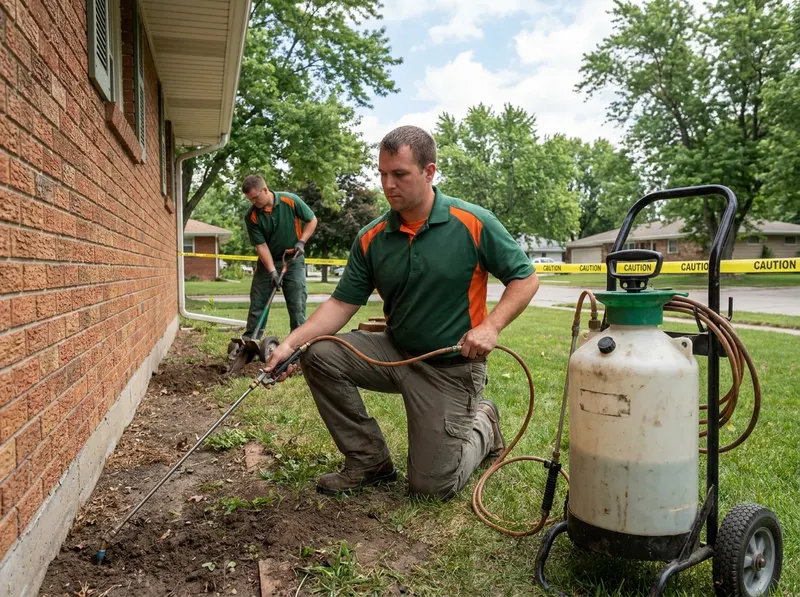
Subterranean termites account for structural timber damage throughout Hall County due to the shallow water table along the Platte River basin. Properties near Stolley Park, Pier Park, and Broadwell frequently feature sandy-loam soil profiles that permit subterranean workers to tunnel up from depths below the regional 42-inch frost line. Termite treatments in Grand Island NE address this movement by establishing a continuous chemical barrier along foundation walls rather than relying on perimeter surface sprays. Surface repellent applications fail because subterranean termites detect treated zones and simply reroute their mud tubes through an untreated foundation crack as small as 1/32 of an inch. A non-repellent liquid termiticide binds to soil particles; foraging worker termites walk directly through the treated substrate without detecting the active agent, carrying the compound back to the subterranean nest where grooming cycles eliminate the reproductive queen.
Treatment selection depends on architectural construction. Monolithic concrete slab foundations, prevalent in Northwest Grand Island and newer subdivisions near the Indianhead Golf Course area, require sub-slab horizontal injection. Technicians drill 1/2-inch holes through interior slab perimeters at 12-inch intervals near utility penetrations and plumbing traps where subterranean access occurs. Crawl space homes common to Capital Heights and historic homes around Downtown Grand Island Railside require trenching along interior stem walls and pier footings to a depth of 6 inches. For homes situated along the high water table near Prairie Creek or East Park, perimeter monitoring stations packed with dense cellulose matrices provide an exterior intercept grid, avoiding liquid run-off risks while intercepting active worker trails.
Homeowners weighing spot treatments against full-perimeter defense face a distinct trade-off: a localized spot treatment carries a lower initial cost but leaves adjoining untreated foundation walls vulnerable if subterranean colonies shift direction. A full continuous perimeter trench creates uniform containment, requiring an initial investment of 4 to 8 hours of technician labor and 100 to 200 gallons of finished liquid dilution depending on the foundation linear footage. Treatments do not require mandatory 12-month auto-billing subscriptions, and termiticide applications are injected deep into soil zones below ground level, eliminating accessible residues on turf or interior living surfaces where pets and children interact.
Every job gets a firm, written price after a free on-site visit.
Tell us about your termite treatments job in Grand Island and we'll send a clear, written quote, usually the same day.
 Kervexa Pest Defense